Miriam Nzululwazi escapes custody and falls to her death
Heart of the HunterMiriam Nzululwazi’s escape from custody ends not in freedom but in a fatal fall from an intelligence building. A quiet walk through an empty corridor carries her from the interview room to a sealed exterior fire escape; when Vincent Radebe finds her hanging above an alley, she lets go. The event turns a controlled space into a trap and leaves Radebe to accept responsibility for her death.
Custody and the escape route
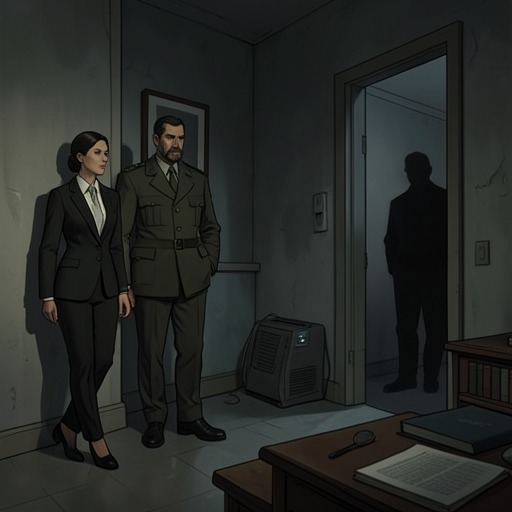
Miriam rises suddenly, opens the interview-room door, and slips into the passage, closing it quietly behind her. The corridor is empty, its cold tiled floor stretching in both directions. She walks toward the end of the passage, where faded, peeling red paint marks a fire-escape door. The scene gives her movement a purposeful quality, but it does not explain what she hopes to find beyond it.
The door opens from the inside under a bar marked “Push/Druk.” Outside, Miriam sees the night and hears the city, but the apparent exit is a dead end. Below her is an alley; in front of her, a metal rail and the rusty remains of a sawn-off metal stairway. The door clicks shut behind her, and there is no handle on its exterior. In a few steps, the possibility of escape has narrowed to a precarious ledge with no way back through the door and no intact stairway down.
The fall
Radebe sees Miriam while returning through the fire door. She is suspended between the building and the ground, her legs swinging out over the drop and back toward the lower platform. Their eyes meet; hers are full of fear. He bends and reaches for her arms, calling her name in despair, and the moment briefly becomes a rescue attempt rather than an escape.
Miriam opens her cramping fingers and lets go. Her swinging body passes the sixth-floor platform and falls without a sound. Radebe watches her turn slowly on the way down and thinks he hears the soft impact on the dirty stone paving far below. The narration does not state why she releases her grip, so the gesture remains devastatingly clear in its consequence but unexplained in its motive: the fall ends her life, while leaving the decisive instant inaccessible to those who witness it.
The scene is set against another thread of the pursuit. Nearby in the narrative, Thobela Mpayipheli waits with a sniper’s scope, becomes conscious of his distaste for what he is doing, and recognizes that this is not the right way to wage war. After Miriam falls, the narrative turns to him riding through the moonlit Free State plains, experiencing a rare sense of unity with his body and the world around him. That juxtaposition does not make her death part of his actions; instead, it places his fleeting experience of life beside the abrupt end of hers, while the larger pursuit continues beyond the building.
Responsibility and confirmation
Afterward, Radebe and Quinn go to Janina Mentz’s office. They remain standing, and when they begin speaking at once, Radebe takes responsibility for reporting what happened. He tells Mentz that Miriam escaped from the interview room because of his neglect, reached the exterior fire escape, and fell six floors. He calls it his fault and offers his resignation, saying that he will no longer be an embarrassment to the department. His account turns the death into an acknowledged custodial failure, not merely an accident discovered after the fact.
Mentz goes cold when she hears the news. She eventually states that Miriam is dead; Quinn confirms it and adds that they carried her back up to the interview room. The blunt movement of the body back inside closes the immediate sequence, but not the questions about how she reached the exit or how the escape became fatal. Mentz asks how Miriam got out, leaving the institutional inquiry open even as Radebe has already assigned himself the blame.
What her death breaks
Miriam’s fall destroys the possibility of the future that she and Thobela had imagined. Earlier, he had insisted that caring for her and Pakamile, returning home, and living by lawful, nonviolent work were part of an honourable life, even as he felt bound to repay his debt to Johnny Kleintjes. He also entertained the hope that the three of them could take Pakamile to the Cala River and begin again. Her death makes that hoped-for family future impossible; the story’s intimate stakes are not separate from Thobela’s larger attempt to choose a different life, but are among the things that attempt was meant to protect.
The later scene with Pakamile underscores the human cost of that loss without spelling out every consequence. When Allison Healy is about to leave him with the Minister’s secretary, Pakamile clings to her hand and says that he wants to stay with her. His anxious refusal makes his need for a trusted adult immediate and visible. Read alongside the earlier dream of taking him away to a new beginning, the moment gives Miriam’s death an aftermath that extends beyond the building: the escape ends in one fall, but the separation and uncertainty remain with the child she leaves behind.